
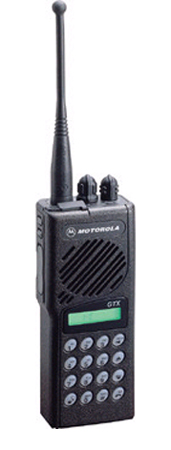
Motorola GTX for 900 MHz Amateur / Ham Radio
Suggestions for how to get started on the 900MHz 33cm ham bandJason Buchanan - N1SU
|
|
Motorola GTX for 900 MHz Amateur / Ham RadioSuggestions for how to get started on the 900MHz 33cm ham bandJason Buchanan - N1SU |
These radios are not designed for hams who are accustomed to programming their own radios, changing frequencies and LCD panel lightshows. But when you press the transmit button and you get MIL-SPEC communication.
My exposure to 900MHz operation says that the extra 3dB from the 30 watt radio is important for use with any antenna that does not have at least 5dB gain. If you don't buy a 5dB gain antenna you will probably want the higher wattage radio. But the lower gain antennas severely limit your listening range and then you wind up talking further than you can hear...
Power connector: Go to your local auto parts store and look for a 2-wire flat connector that is used for powering tail lights on a boat trailer, etc. The 12V positive from your car should be connected to the lead that terminates in the plastic shroud, the ground from your car's chassis should be connected to the pin that is bare. The reason for this is that if the power connector is pulled out of the radio the 12V positive lead will not ground or short against a bare metal floor or panel. Plug this connector into the back of the radio. The positive lead on the radio is not enclosed in a plastic shroud. An ohmmeter should show 0 ohms from the shield of the mini-UHF connector to the power terminal enclosed in the plastic shroud on the radio.
Microphone: There are 3 microphone possibilities - the cheap plastic one in the photo above or the heavy duty HMN1035 (big, with 10' cord) or HMN1056 (smaller with 7' cord). I've used the large and small heavy duty models, they sound the same but I like the larger one because my GTX is mounted far enough away that the shorter cord is a little inconvenient.
The Motorola microphones work best with a genuine hang-up clip, HLN9073B. The surface of the microphone's hang-up post completes a circuit when it is in the metal hang-up clip and allows an RSS-configurable option to resume the SCAN mode in the radio when the microphone is in the hang-up clip. Motorola has the smaller HMN1056D microphone and HLN9073B hang-up clip bundled together as a kit, model HMN3220B.
16pin ASM accessory plug: This isn't absolutely required but in terms of being practical it's better to buy the 16 pin female plug and enjoy the radio. The GTX has a 16 pin plug that enables various things that law enforcement and other commercial users would want. The drawback to this is you can't just plug the power into the radio and use it. The radio has a pin to sense 12 volts from your car's ignition so that the radio will power on when you turn the ignition key, and turn the radio off when you turn the key off. Even if you turn off the "power switch" on the radio it will still come on when the ignition power is there on pin 10, but it won't come on at all until pin 10 sees 12 volts. This is where the plug can come in very handy because you can steal voltage off of pin 4 or pin 9 to feed pin 10 and make the radio come on and stay on as long as 12 volts is coming to the voltage input plug. The downside of this is the radio is on all the time so you need to find a 12 volt ignition-sense source in your car so the radio will shut off and not drain your battery when the key is off. Wiring pin 10 hot all the time is useful if you move the radio from one car to the other and use a magmount antenna, etc. The plug also has pinouts for an external speaker (do not ground the speaker to the car or you will blow up the radio - the wires to the speaker must not be grounded at all). The internal speaker is traditional Motorola quality, meaning it has good fidelity and is LOUD.
I got my 16pin ASM plug from eBay seller rcbi. Carl is a great guy and I highly recommend this seller. Ask Carl for a plug wired specifically for the 900MHz GTX if one isn't currently listed. It's the best thing you can buy for your GTX, just do it.
Antennas: Buy the highest gain antenna you can find. I bought a Larsen antenna because they have always been excellent. The Radiall/Larsen NMO5T900B is a 5dB gain antenna. You will need an NMO mount for this antenna. NMO means "New Motorola" if you were wondering. NMO mounts are reasonably waterproof if installed properly but the underside is not waterproof - you have to gob it up with tons of silicone sealant if you use an L-bracket to mount the antenna along the edge of your trunk (not to be confused with the trunk-lip bracket that attaches to the hinged trunk lid) or front hood. I put the antenna along the rear quarter panel next to the trunk. NMO mounts were designed to be mounted inside a 3/4" hole in a trunk or somewhere in the auto body. 900MHz 33cm transmission does not suffer like 6m, 2m or 440MHz 70cm does when mounted on the side of the car. Save the hole drilling for 6 meters.
I bought mine from Radio Outfitter but Tessco is popular by most hams and the Antenex BB8965C sold by Waltel is another option. I'm a Larsen guy so I chose the Larsen NMO5T900B from their Cellular/SMR/Data 800 and 900 MHz product line (see page 11). The closed coil model is a little more wiry but this is a good thing if you use a trunk lip mount and need the antenna to bend a little when you open the trunk.
Coax: You want the lowest loss coax you can snake through your car's interior to get to the mini-UHF connector on the back of the radio. RG-8/X is a good choice, LMR195 is an excellent choice (is the same diameter as RG-58), LMR240 is an even better choice. RG-8/X and LMR195 have approximately the same loss, LMR240 is about 1dB less under perfect conditions (minimal bending). Obviously you don't want to bend the coax tightly - if it's sharper than a coffee can it's too sharp for 900MHz.
I have been told that Motorola has an NMO/LMR195 bundle and i'm trying to track the part number down - I will update this page with that information when I get it.
On the lighter side, programming these radios isn't so hard, actually. You just have to have the right equipment for the job and preferably an experienced person sitting next to you to help you learn. The RSS software was designed for SLOW computers - a 2GHz Pentium will not work at all. If you lose power or if the connection to the radio is interrupted during the programming stage the radio becomes a dead brick and you're screwed (make sure your power supply for the radio AND the PC are capable of running if the power goes out). Most importantly, Motorola requires a license for the RSS software for your particular model of radio. Read this link for more information - it says it all.
The RadioStew RIB is about $70 and the RSS license is around $200 which is not cheap but it's an excellent product and works with the "RIB-less" cables on eBay.

A big thanks to Roger WA1NVC, Rob W2IO, Will N1PXA and Paul K6EH for their
help!

|
| Subscribe to 33cm |
| Visit this group |
